Planting / Illustrative garden study
Hillside Planting
A garden that follows the ground: loose planting, quiet stone edges and a path that invites a slower journey. This fictional concept explores the relationship between changing levels and an enveloping planting palette.
Generated photographs illustrate a design direction. This is not a completed commission or a construction proposal for a surveyed site.
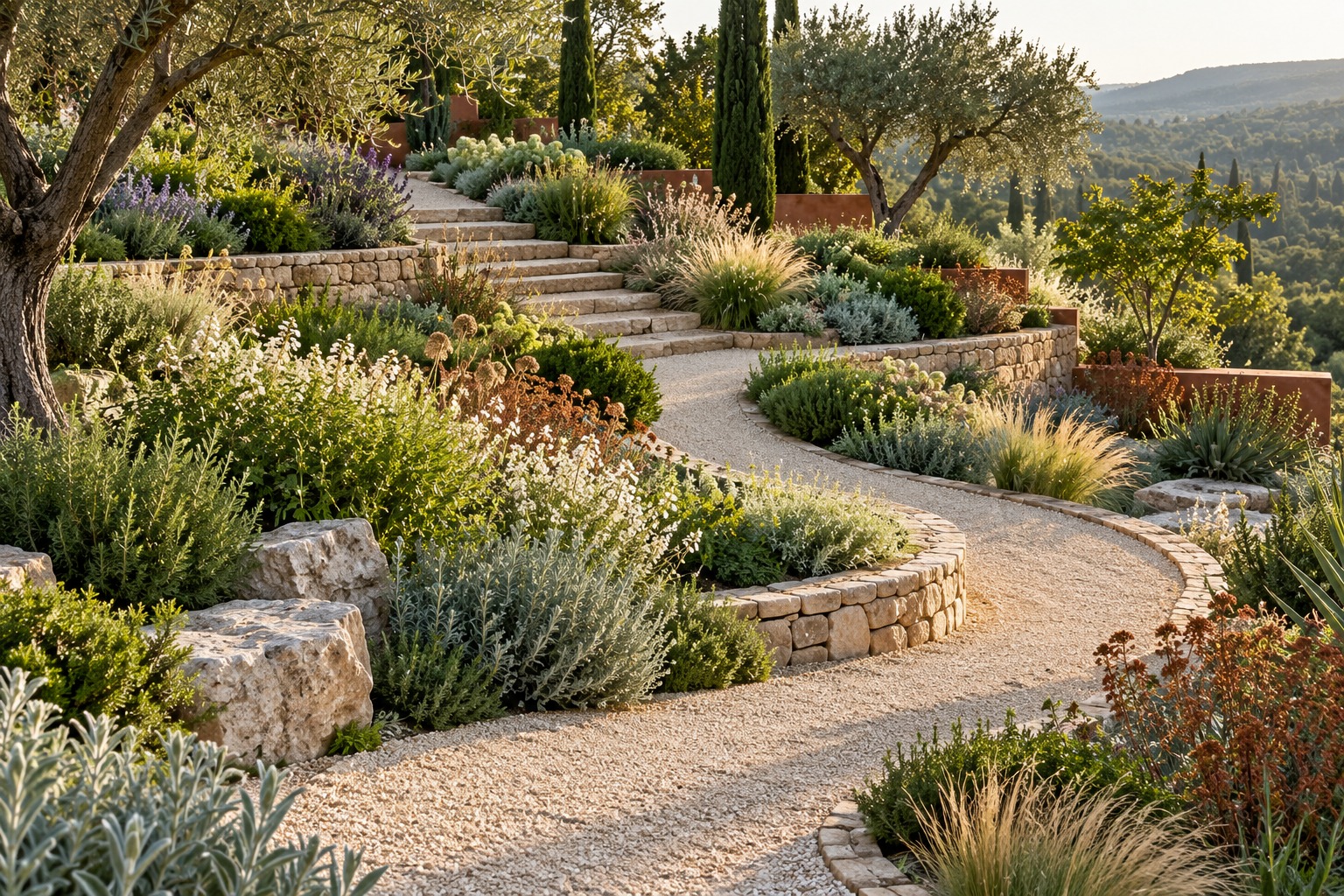
Working with the contours.
- Setting
- Fictional sloping residential garden
- Brief
- Connect levels and create places to pause
- Approach
- Contour-led paths and restrained stone edges
- Planting character
- Grasses, textured foliage and seasonal perennials
The brief
The imagined garden needs a route that feels connected to its slope, with planting that can be enjoyed from above and at close range. Instead of treating the whole site as one broad view, the concept introduces a sequence of smaller experiences: a turn in the path, a stone edge and a pause beside moving grasses.
The response
Repetition gives the planting a clear rhythm. Groups of grasses link areas of perennial planting, while a restrained stone palette allows changes in texture to remain visible. The route leaves space for plants to mature without assuming that growth will stay within the boundaries shown in the illustration.
Gravel is a visual proposal here, not a confirmed accessible surface specification. Gradient, firmness, drainage and intended users would determine the appropriate path construction. Retaining structures, ground stability and water movement require site-specific assessment before design decisions are finalised.
Material decisions
Stone should be selected with weathering, local conditions and construction requirements in mind. Edge details need to accommodate maintenance and prevent loose material from migrating into planting or onto adjoining routes.
Room to grow, access to care.
Specify plants after assessing exposure, soil and drainage. Establishment care should respond to root-zone moisture and weather. Avoid assuming that a drought-adapted palette needs no attention while roots establish.
Allow maintenance access throughout the planting. Inspect edges and drainage points, remove encroaching growth and review surface stability. Any structural movement needs appropriate professional assessment.
Plan cutting back around the selected species and local conditions. Observe which plants crowd their neighbours and which areas need adjustment before adding more plants.
Continue exploring: Courtyard Retreat · Evening Terrace · All garden studies