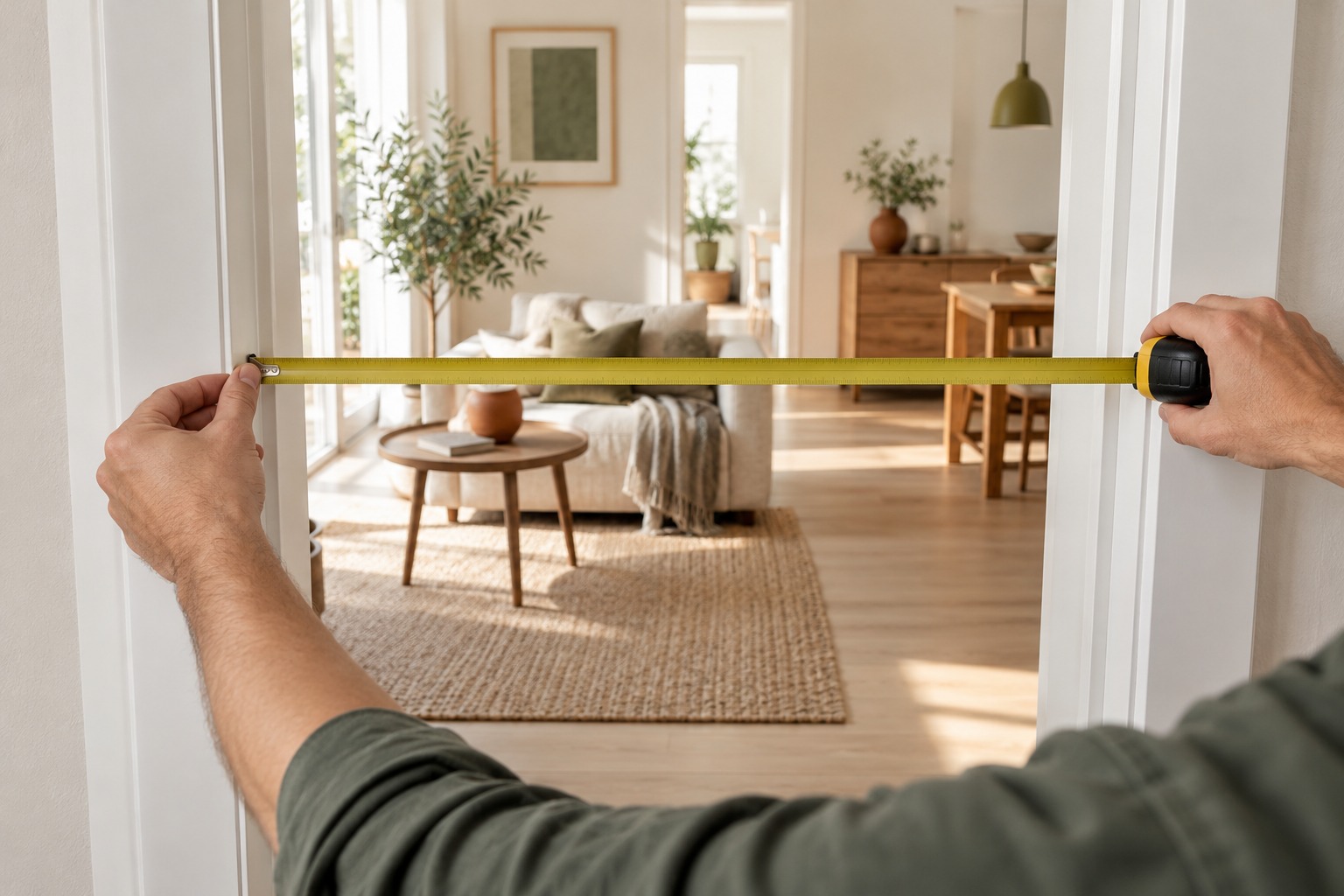
A piece of furniture occupies more than the rectangle beneath it. A chair moves backwards, a cupboard opens forwards and a sofa changes the path through a room. Before choosing, measure both the object and the way you will live around it.
Start with the room you have
Draw a simple plan and mark doors, windows, radiators and sockets. Measure the usable wall lengths, including interruptions such as skirting boards and projecting fittings. Record the units alongside every measurement so that a later comparison does not mix centimetres and inches.
Keep the furniture you intend to retain on the plan. Then mark the proposed footprint with paper or a suitable removable floor marker. Walk through your normal routine: enter with a bag, pull out a chair, reach a cupboard and sit down. A floor outline is a useful prompt, but remember that it does not show height or visual weight.
Read the dimensions carefully
Find the product’s width, depth and height. For seating, ask about seat height and usable seat depth if these matter to your choice. For storage, check internal dimensions and the space needed for doors or drawers. For a table, consider the base as well as the top: the arrangement beneath affects where chairs can sit.
Do not estimate dimensions from a photograph. Camera angle and styling can change the apparent scale. Our demo dimensions are authored fictional specifications; a live merchant must replace them with verified product data.
Trace the delivery route
Begin outside the building and follow the route to the final room. Measure clear doorway openings rather than the surrounding frame. Note tight turns, stair landings, overhead restrictions and the usable dimensions of any lift. Building access rules can matter as much as the physical opening.
Ask the merchant for packaged dimensions, weight and any handling requirements. Confirm whether legs or other components can be removed and who is permitted to do that. A smaller assembled footprint does not prove that a packaged item can pass a narrow turn.
Bring uncertainty into the conversation
If access is close, send your measurements and a description of the route before ordering. Ask what the delivery service includes, whether assessment is available and what happens if access is unsuitable. Do not rely on an assumed diagonal manoeuvre or on removing packaging without confirmation.
Keep one useful record
Save the product name, chosen finish, dimensions, route notes and the merchant’s answers together. Recheck them if you change the size or configuration. That record gives you a clearer basis for a decision than a collection of inspiring images alone.
Read the delivery preparation checklist or explore the room stories.