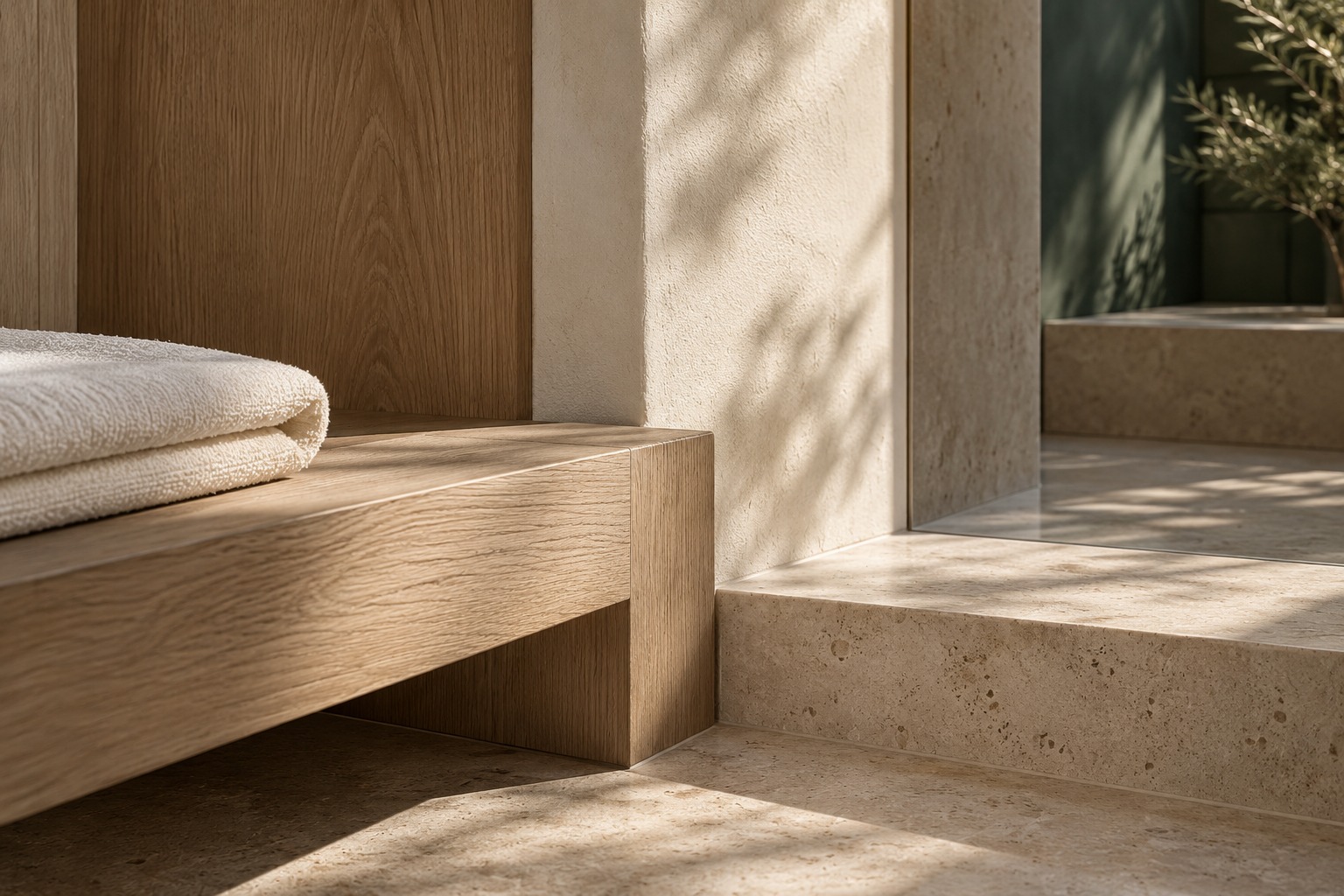
The character of a room often sits in the parts you notice slowly. Light falls across a wall, the edge of a bench feels smooth beneath a hand, and a curtain softens the view without closing it away. At Quiet Meridian, these are the details that guide the space.
Wood brings variation
Oak has a visible grain that changes from one board to the next. In the reception desk and joinery, that variation gives broad, simple shapes something to look at without adding ornament. The forms remain quiet, while the surface rewards a closer view.
A restrained palette allows those differences to remain visible. The wood does not have to match every other surface perfectly to feel at home beside it.
Stone gives the room a base
Pale limestone sits alongside the warmer timber. Its subtle markings and honed appearance provide a different kind of texture: less directional than grain, more gradual in the way light moves across it.
We like the meeting point between materials as much as the materials themselves. A clean join, a considered edge and enough space around an object can make a simple arrangement feel intentional.
Linen changes the light
Fabric introduces a softer edge. A curtain can hold daylight gently, while folded linen adds a familiar scale to a treatment room. These are practical objects as well as visual ones, and they belong in the space because they are used.
The photographs catch one moment, but a room is never still. A brighter morning and an overcast afternoon reveal different tones in the same wall. Keeping the finishes restrained leaves room for that change.
Space is a material too
Not every corner needs an object. Clear circulation space, a place to put a bag and a comfortable route from reception to the treatment room are part of the composition. The aim is a room that is straightforward to occupy, with details that do not compete for your attention.
The conversation