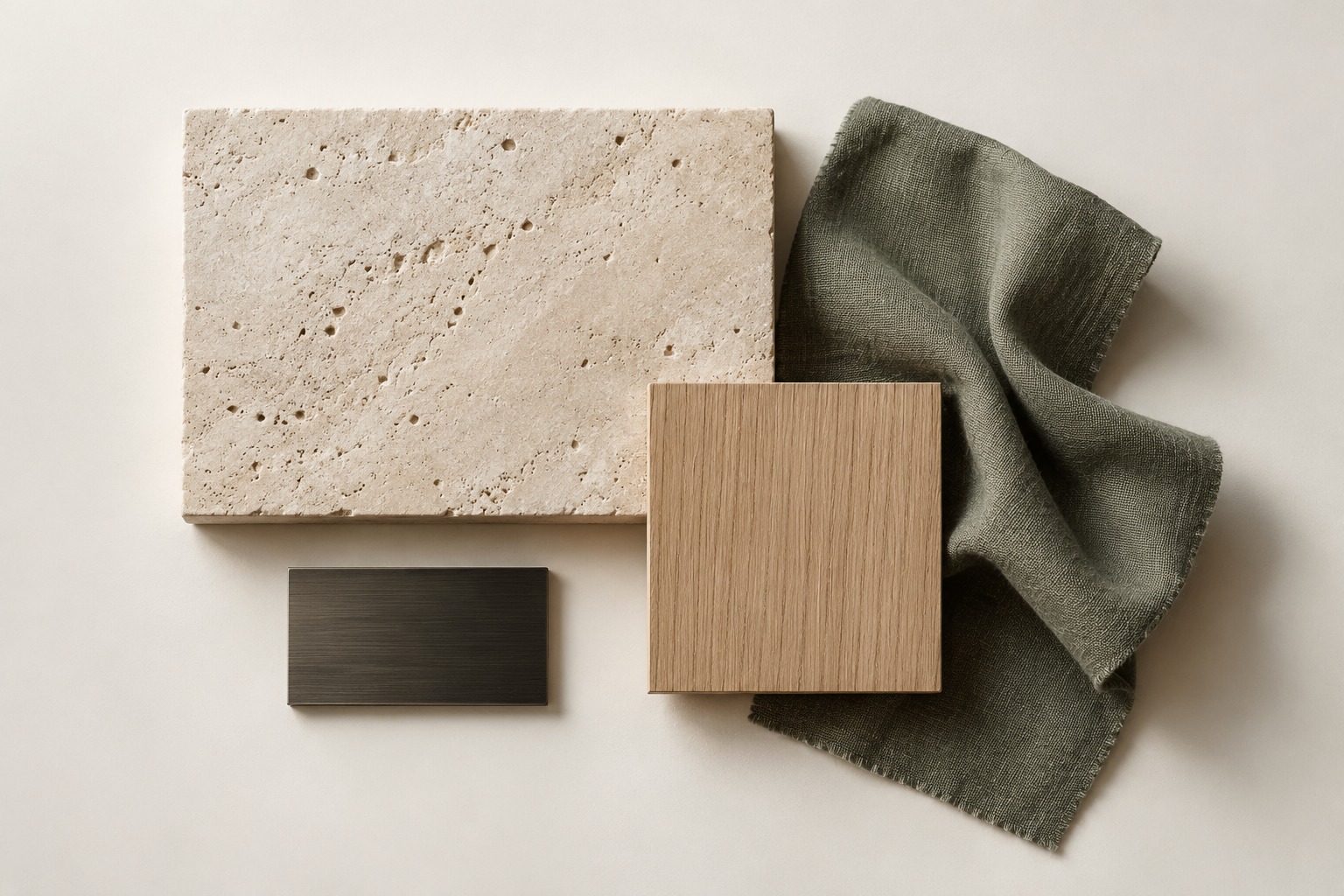
A considered material palette does not require every surface to match. Its character often comes from the relationship between different textures: the open grain of timber beside smooth stone, or a softly woven cloth against a precise metal edge.
Begin with the largest surface
Choose a starting point from the elements that will occupy the most visual space. This may be an existing floor, a substantial wall finish or a piece of furniture you intend to keep. Let that material establish the temperature and depth of the palette.
Give each material a role
In this illustrative arrangement, pale oak brings grain and warmth, limestone offers a quieter mineral surface, olive linen adds softness and dark metal defines a small edge. The materials differ, but none needs to compete for attention.
- Use a background material to connect larger areas.
- Introduce a contrasting texture where touch matters.
- Reserve stronger accents for details you want to notice.
Compare physical samples
Collect samples large enough to show variation. Place them together in the actual room and examine the transitions: floor to wall, upholstery to joinery, handle to door. Photographs and screens are useful for discussion, but they cannot replace physical inspection.
Think beyond the first photograph
Ask suppliers how each finish should be cleaned, how it responds to regular use and what variation to expect. Choose surfaces that suit the people using the space. Record maintenance information alongside the specification so it remains available after installation.
A palette becomes convincing when its appearance and practical role support one another. Begin a conversation about your space.
Editorial demo content. Materials shown are illustrative and do not imply certification or supplier endorsement.
Join the conversation